Home
Share Internet News
Share Internet News
XX Information Network - Domestic and foreign news, current affairs, strange things, and new things

Updated: 2019-09-25 11:15:52Views:
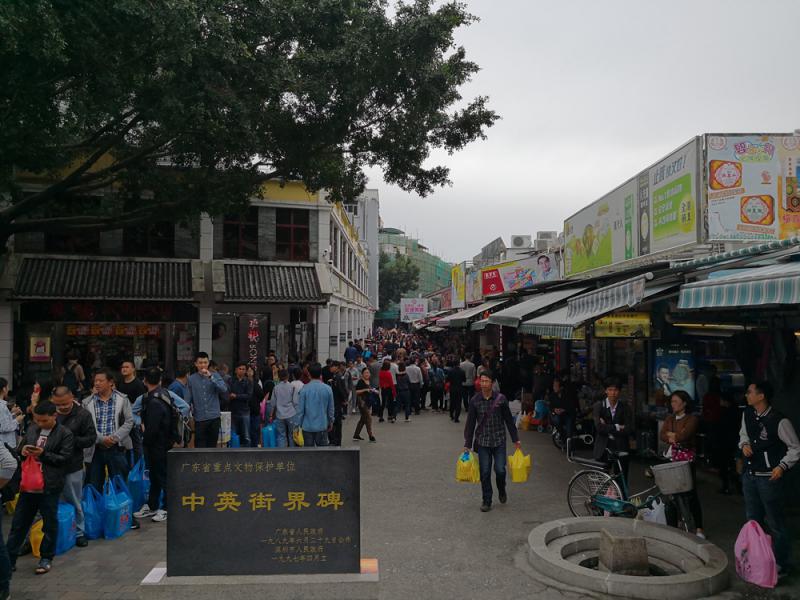
Picture: Tourists lining up around the Zhongying Street boundary marker waiting to exit the customs/photographed by Ta Kung Pao reporter Guo Ruoxi
The sun rises on Shatou and the moon hangs over the sea. On the land border connecting Shenzhen and Hong Kong, there is an old street that has risen and fallen in the changing times, witnessing the century-old destiny of the nation and China's opening up to the outside world. It is divided into Shenzhen and Hong Kong by eight boundary monuments. This is the world-famous Sino-British Street. Over the past 70 years, this once "demarcation line" and "shopping paradise" has now set sail again in the upsurge of the construction of the Guangdong-Hong Kong-Macao Greater Bay Area. It has been given a new positioning as the "Shenzhen-Hong Kong International Tourism Consumption Cooperation Zone", showing a new round of rise and heading towards a new journey of high-quality development. /Reported by Ta Kung Pao reporter Guo Ruoxi
The main street of Sino-British Street is about 250 meters long and less than 7 meters wide. The eight Sino-British boundary monuments that are still preserved today have become historical witnesses of British colonialism’s invasion of China. Walking into the intersection of Zhongying Street from Shatoujiao in Yantian District, Shenzhen, you will see the No. 1 boundary marker of Zhongying Street. This is now the most popular attraction on Zhongying Street, and tourists will stop and take photos.
In March 1899, the Qing government and the British determined the northern boundary of the New Territories, and Sha Tau Kok was divided into two parts: the "Chinese boundary" and the "British boundary". Due to the production and living needs of residents on both sides, this Sino-British Street gradually formed along the "Sino-British dividing line".
Along the side street towards the Chung Ying Street Museum, there is a row of sculptures showing the history of Chung Ying Street. The most famous group is based on a historical photo taken by American Life magazine photojournalist Burns. It reflects the scene in Sha Tau Kok in 1950 when China and Britain set up sentries on the street. On one side stood the People's Liberation Army and on the other stood the British Hong Kong government police. "Back then, when the two people first met, their eyes were full of hostility. Later, after they got acquainted, the two people actually reached out and shook hands across the boundary marker." Sun Xiao, the first director of the Zhongying Street History Museum, said.
Sha Tau Kok took the lead in reform and opening up
As a native villager, Sha Jintao, who was born in 1946, remembers that when he was a child, the mainland side of Chung Ying Street was a small village with a sparse population. Most of the villagers made a living by farming and fishing, while the Hong Kong side had many shops and bustling commerce. "In the 1960s and 1970s, the economic development of Shenzhen and Hong Kong was uneven, but the friendship between the residents of the two places never left. At that time, it was popular to give away the 'three fives', which were five pounds of sugar, oil, and noodles. Residents used this to give each other gifts to continue the friendship between the two sides."
The reform and opening up that started forty years ago brought spring to Zhongying Street. Sha Jintao was selected to engage in investment promotion work because of his experience working in a state-owned store. "Shatoujiao was the first in the country to raise the banner of commercial and trade reform, making Zhongying Street the forefront of reform and opening up at that time."
Revitalizing and transforming into an international business district
Director Sun told reporters that before the reform and opening up, there was a big gap in the living standards of residents on both sides of Zhongying Street. The annual income of Hong Kong residents was HKD 6,700, while that of Shenzhen residents was only more than 100 RMB. After the reform and opening up, Zhongying Street relied on its window advantage to become a famous "shopping paradise" in the 1980s. During the peak period, more than 100,000 tourists could flow in every day.
"You can't walk at all. The people behind you are pushing you forward, and you can't move if you don't move. In the early days on the streets in the mainland, they wore wide trousers and toad glasses, and carried a Sanyo tape recorder in their hands. Most of them were Teresa Teng's songs, and many of them were sold at Zhongying Street. Gold sales were booming in 1986. Buying gold at that time was not done on a piece-by-piece basis, and the money seemed not to be counted. That was because it was too late! According to statistics, the sales of Zhongying Street in 1979 were 5.9 million yuan, which increased to 1.568 billion yuan in 1988.
"At that time, many people became rich overnight. Among my friends, there are now 8-10 people with a net worth of one billion. They all became prosperous in the 1980s." Sha Jintao said.
With the opening of free travel in Hong Kong and more and more Chinese people going abroad, the number of tourists visiting Zhongying Street once decreased. In the new era, Sino-British Street has become popular again, showing a new rise.
According to Li Jinquan, director of the Zhongying Street Administration Bureau, driven by the development plan of the Guangdong-Hong Kong-Macao Greater Bay Area, the Zhongying Street area has become a core area in the Shenzhen-Hong Kong International Tourism Consumption Cooperation Zone. "We also plan to comprehensively plan and build a duty-free shopping street with international famous brands to revitalize business vitality. We also encourage young people from Shenzhen and Hong Kong to innovate and start businesses here, especially in areas such as artificial intelligence, life and health, high-end modern service industries, etc., and to create in-depth grassroots social governance, social integration, cultural inheritance and promotion."





